How to Start an Escape Room Business
Locks, clues, a ticking clock and a lease you actually have to pay. Here is the real playbook for opening an escape room.
 The GoFish.Rocks Team•November 23, 2026•6 min read
Every escape room owner has the same origin story. They played one, loved it, walked out and said, “I could build a better one.” Then they found out what a commercial lease costs.
Good news: an escape room business can absolutely work. People pay per head, groups book in advance, and a room you build once can sell the same hour slot hundreds of times. The trick is starting with your eyes open (and your budget in a spreadsheet, not on a napkin). Here is how to start one, step by step.
Escape room business: how to start one in 7 steps
1. Pick your rooms before you pick your building
Decide how many rooms you want and how big each one is. A two-room venue and a five-room venue need very different spaces. Most groups run 2 to 8 players, so think about how many people each room holds and how many sessions you can run in a day. That number drives everything else, including rent you can afford.
2. Know what it really costs
Costs swing a lot by city and by how fancy your rooms get. Here is what two 2026 startup guides put on paper:
| Cost item | Estimated range |
|---|---|
| Lease deposit and first month’s rent | $5,000 to $15,000 |
| Room build-out and theming, per room | $10,000 to $40,000 |
| Total startup, small to mid venue | $26,000 to $113,000 |
Lease and build-out ranges from ZenBusiness’s escape room venue guide. Total range from Jim’s 2026 escape room startup guide.
Notice that room build-out is per room. Three rooms at the high end is $120,000 before you buy a single padlock. (You will buy a lot of padlocks.)
3. Choose a location people can find
Escape rooms live on group bookings: birthdays, date nights, team-building outings. That means parking, visibility and a spot near restaurants matter more than a cheap back-alley warehouse. Talk to your local planning department early. Occupancy limits, fire exits and building permits are not the fun part, but they decide whether you open on time.
4. Set up the business side
Form your company, get your EIN, open a business bank account and line up insurance. The SBA’s business guide walks through the structure and registration steps. Insurance gets its own post later in this series, because “a customer tripped over the treasure chest” is a sentence you want covered.
5. Design rooms that are hard, not unfair
The best rooms feel tough but solvable. Players should leave saying “so close!” and not “that puzzle made no sense.” Build a clear clue path, test each room with real groups and time every run. If nobody escapes in your first ten tests, the room is broken, not your players.
6. Get booking right before opening day
This is where a lot of new owners trip. You need customers to see open time slots, pick a room, pay and get a confirmation, all on your own website, all from their phone. Then you need reminders so groups actually show up.
GoFish.Rocks does that for escape rooms the same way it does for charter boats. Time slots, capacity limits, online checkout on your site and automated texts and emails for confirmations and reminders. See the full booking software for escape rooms page for how it is set up.
7. Price per person and watch your fees
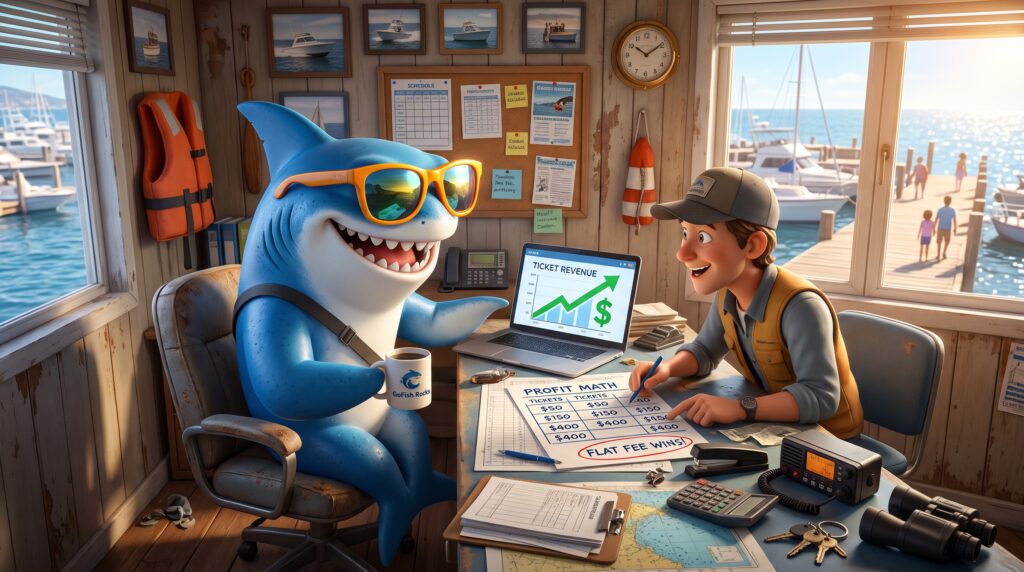
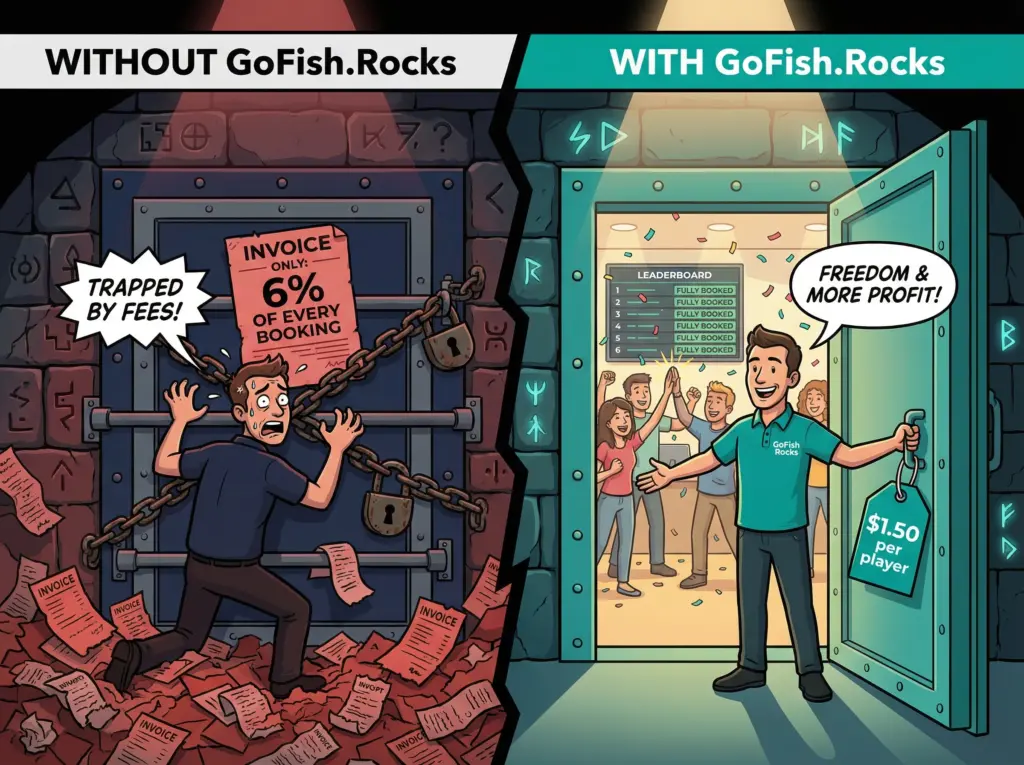
Escape rooms charge per player. Say you charge $35 a head and a group of six books. That is $210. Now look at what your booking system takes out of it.
GoFish.Rocks charges a flat $1.50 per person, billed once at the end of the month. No setup fee, no contract and no charge on canceled bookings. The 6% is an example rate, not any named company’s. Bump your ticket price to $45 and the percentage takes more while the flat fee stays put. Full details are on the pricing page.
Payments go straight into your own merchant account through Stripe, Square, Authorize.net or our billing and payments setup. GoFish.Rocks never holds your money, and most owners see deposits the next day.
Mistakes that sink new escape rooms
Do
- Budget per room, not per venue Money
- Test every room with strangers Rooms
- Send reminders the day before Bookings
Don’t
- Sign a lease before you know your room count Money
- Only test rooms on your friends Rooms
- Take bookings by phone and paper Bookings
Bottom line
Starting an escape room business comes down to four things: a realistic budget, a findable location, rooms that are fun to lose in and a booking system that fills your slots without you babysitting it. Get those right and the rest is clues and duct tape.
Want to see how booking would work for your rooms? Get your free demo or call 805-871-0044. Setup, training and migration are free.
Frequently asked questions
How much does it cost to start an escape room business?
Startup guides from 2026 put a small to mid venue at roughly $26,000 to $113,000. Room build-out alone runs about $10,000 to $40,000 per room, so your room count matters most.
How many rooms should a new escape room open with?
It depends on your budget and space. Many owners start with two or three rooms so they can run several groups at once without a huge build-out bill.
What booking software works for escape rooms?
You want time slots, capacity limits, checkout on your own website and automated reminders. GoFish.Rocks does all of that for a flat $1.50 per person.
Do escape rooms charge per person or per room?
Most charge per person, with a minimum group size. That is why a flat per-person booking fee is easy to plan around.
Open your doors with booking that works
Time slots, reminders and checkout on your own website, for a flat $1.50 per person. See Escape Room Booking →