Which Ticketing Platform Maximizes Profit Per Ticket?
Run the fee math at $50, $150 and $400 tickets and find the price where a flat fee beats a percentage.
 The GoFish.Rocks Team•November 6, 2026•6 min read
Raise your ticket price by $100 and ask yourself one thing. Did your booking software do $100 more work? It sent the same confirmation. It printed the same manifest. So why would its fee go up?
That question sits at the heart of which ticketing platform maximizes profit per ticket. The answer depends less on the brand and more on the fee model. A percentage fee grows with your price. A flat fee does not. In this post we run the numbers at three ticket prices, find the break-even point, and talk about passing fees to guests. If you want the short version first, our flat-rate pricing page shows the same idea in one table.
How do boat tour tools differ in pricing and usability?
Most tools fall into a few buckets. Some charge a percentage of each booking. Some charge a percentage plus a small flat amount, with formulas like “$0.79 + 2%” or “2.9% + a flat fee.” Some charge a flat amount per person.
Usability matters too, but it is harder to put in a table. A tool that keeps checkout on your own site, sends reminders on its own and closes double bookings will save you time. Time is profit too, it just doesn’t show up on the fee line.
For this post, we focus on the fee line. That is where the math is clear.
Which ticketing platform maximizes profit per ticket at $50, $150 and $400?
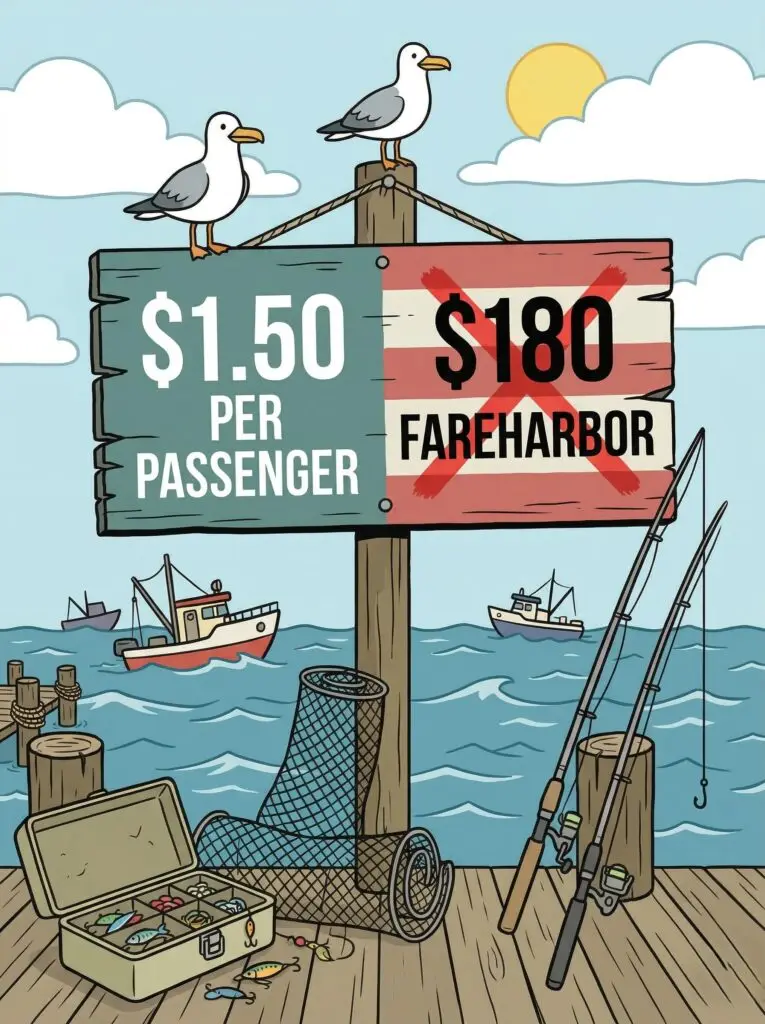
Here is what each fee model takes from one ticket. The percentages are example rates only, not any named company’s rate. GoFish.Rocks charges a flat $1.50 per passenger.
| Fee model | $50 ticket | $150 ticket | $400 ticket |
|---|---|---|---|
| 3% example | $1.50 | $4.50 | $12.00 |
| 5% example | $2.50 | $7.50 | $20.00 |
| 6% example | $3.00 | $9.00 | $24.00 |
| $0.79 + 2% example | $1.79 | $3.79 | $8.79 |
| GoFish.Rocks flat | $1.50 | $1.50 | $1.50 |
Example math only. Booking fee only, before card processing. Percentage rates are common rate levels, not a quote from any one company.
Look at the $50 column. A 3% fee and the flat fee are tied. Now look at the $400 column. The gap is $7.29 to $22.50 per ticket. The higher your ticket, the more a percentage costs you.
Here is the same idea on a $150 ticket, drawn as bars (because some of us think better in pictures).
The break-even ticket price
Here’s the thing. Below a certain ticket price, a percentage can cost less than a flat fee. Above it, the flat fee wins. That point is easy to find. Divide the flat fee by the percentage.
- At 3%: $1.50 divided by 0.03 is $50. Above a $50 ticket, the flat fee costs less.
- At 5%: $1.50 divided by 0.05 is $30.
- At 6%: $1.50 divided by 0.06 is $25.
- At $0.79 + 2%: the two meet at about $35.50.
So ask yourself: what is your cheapest ticket? If it is over $50, a flat $1.50 fee costs less on every ticket you sell against all four example models.
Kids’ tickets count too. If you sell a $20 child fare, a percentage may be cheaper on that one seat. Run the math on your real ticket mix, not just your adult price.
One more thing to know about charters. On GoFish.Rocks, private charters have a 6-passenger minimum, so the smallest fee is $9.00 per charter. On a $2,000 charter with 12 guests, that is $18, compared with $120 at an example 6% rate.
Run the math on one trip
Per-ticket numbers can look small. So let’s put one boat behind them. Say you run a trip with 20 guests at $150 each. That is $3,000 in tickets.
- 6% example fee: $180 for the trip.
- 3% example fee: $90 for the trip.
- GoFish.Rocks flat fee: 20 guests times $1.50 is $30.
Same boat, same guests, same fuel. The only thing that changed is the fee model. Now bump the ticket to $400 and do it again. The flat fee stays at $30. The 6% example fee jumps to $480.
Card processing is a separate cost on top of any booking fee, and it is usually a percentage no matter which booking tool you use. Ask each vendor who the processor is. GoFish.Rocks plugs into your own merchant account, so you can see those costs for yourself. Our guide to billing and payments explains how it works.
Passing fees to guests
You can pass a booking fee to your guest instead of paying it. That does not make the fee go away. It just moves it to the guest’s side of the receipt. And guests notice a big fee at checkout (they notice it the way you notice a new noise in the engine).
On a $400 ticket, a passed-on 6% example fee adds $24 to the guest’s total. A passed-on flat fee adds $1.50. Which one is easier to explain at the dock?
With GoFish.Rocks, you pick. Pass the $1.50 to your guests, or absorb it.
Do
- Show the full price early in checkout Pricing
- Keep any passed-on fee small and clear Guests
- Test the fee at your highest ticket price Math
Don’t
- Add a surprise line at the last step Pricing
- Assume guests won’t notice a percentage Guests
- Only test your cheapest ticket Math
Honest pricing is also a legal topic now. According to the FTC’s fee rule FAQ, the rule applies to businesses that offer live-event tickets or short-term lodging, and they must tell people the total price upfront. Check with your own advisor on whether it covers your trips. If you sell in California, read our page on the California honest pricing law too.
Does booking software have hidden fees?
Sometimes the fee you see is not the only fee. Ask about fees on refunds, fees on weather cancellations, monthly minimums and setup costs. On GoFish.Rocks, there is no setup fee, no monthly plan and no contract. Canceled and refunded bookings cost $0. You are billed at month end, only for guests on trips that sailed. See more on pricing transparency.
Bottom line
The platform that maximizes profit per ticket is the one whose fee does not grow when your price does. Find your break-even ticket price, check your ticket mix, and decide who pays the fee. Then compare. For a wider look at pricing models, read subscriptions versus passenger pricing.
Frequently asked questions
Which ticketing platform maximizes profit per ticket for boat tours?
For tickets above $50, a flat per-passenger fee like GoFish.Rocks’ $1.50 costs less than a 3% fee. The higher the ticket price, the bigger the gap.
How do I find my break-even ticket price?
Divide the flat fee by the percentage rate. For $1.50 and 3%, that is $50.
Should I pass booking fees to my guests?
You can, but the guest still pays it at checkout. A small flat fee is easier to explain than a percentage on a pricey ticket.
Does booking software have hidden fees?
Some can. Ask about refund fees, weather cancellation fees, setup costs and monthly minimums before you sign.
Keep more of every ticket
GoFish.Rocks charges a flat $1.50 per passenger, per trip. No percentage, no setup fee and no monthly plan. See How It Works →