Captain’s License: Which One You Need and How to Get It
Six-pack or Master? Here is what each captain’s license lets you do, what the Coast Guard wants from you, and how to get through the paperwork.
 The GoFish.Rocks Team•November 26, 2026•6 min read
You have been running your buddy’s boat for years. You know every reef, every rip and every guy at the fuel dock by name. Then somebody offers to pay you for a trip, and suddenly you need a piece of paper from the Coast Guard.
That paper is a captain’s license, and if you want to take paying passengers out, you need one. Officially it is part of your Merchant Mariner Credential (MMC), issued by the US Coast Guard’s National Maritime Center. Unofficially it is the thing standing between you and your first charter business. Let’s sort out which one you need and how to get it.
The two captain’s licenses charter operators get
Most charter captains start with one of two licenses:
| OUPV (Six-Pack) | Master | |
|---|---|---|
| Paying passengers | Up to 6 | More than 6 |
| Boat type | Uninspected vessels | Inspected and uninspected vessels, by tonnage |
| Minimum age | 18 | 19 |
| Sea time | 360 days | 360 to 720 days |
Sea time ranges reported by captain’s license schools Mariners Learning System and Maritime Institute. The Master near coastal license needs 720 days. Always confirm against the official checklist.
Running a six-person fishing charter? The OUPV, better known as the six-pack, is usually the one. Running a party boat, a dinner cruise or a whale watch with 40 people aboard? You need a Master license on an inspected boat.
What the Coast Guard wants from you
The checklist is long but not mysterious. For an OUPV or Master license, plan on all of these:
Your captain’s license checklist
Check them off as you go. Your future self will thank you.
- Sea time. 360 days of documented time on the water for OUPV, with some of it recent. Days on friends’ or family boats count if the owner signs the CG-719S sea service form.
- A TWIC card. The Transportation Worker Identification Credential, issued by the TSA after a background check.
- A physical exam. Done by a doctor on the Coast Guard’s medical form.
- A drug test. A DOT 5-panel test.
- CPR and first aid. Current certification from an approved course.
- The exam. Pass a Coast Guard approved course and its exam, or test at a Coast Guard exam center.
- The application. Submit everything to the National Maritime Center and wait for approval.
How a “day” of sea time is counted
According to Mariners Learning System, a day of sea time is normally 8 hours on the water, but the National Maritime Center often accepts 4 hours as a day for OUPV and Master licenses up to 100 tons. Translation: that half-day trip you took every Saturday for six years probably counts. Start digging out old logbooks and texts now. (Yes, even the trip where the bait cooler went overboard.)
Where you got your sea time matters. Mariners Learning System notes that at least 90 of your 360 days must be on ocean or near coastal waters, or your license will be limited to inland waters.
How to get a captain’s license, step by step
- Count your days. Fill out a CG-719S for each boat. Get owner signatures now, while everyone still remembers you.
- Apply for your TWIC. It takes time, so start early.
- Take the course. Most people take a Coast Guard approved course online or in a classroom and test at the end.
- Knock out the medical stuff. Physical, drug test, CPR and first aid.
- Send it in. Submit your package to the National Maritime Center.
Once you have it, your credential is good for five years. Put the expiration date on your calendar now, so you don’t end up scrambling the month before peak season.
After the license: running it like a business
New captains spend months on the license and about five minutes thinking about bookings. Then the phone starts ringing at 9 pm and the deposits are on sticky notes. Set up your booking before your first paying trip.
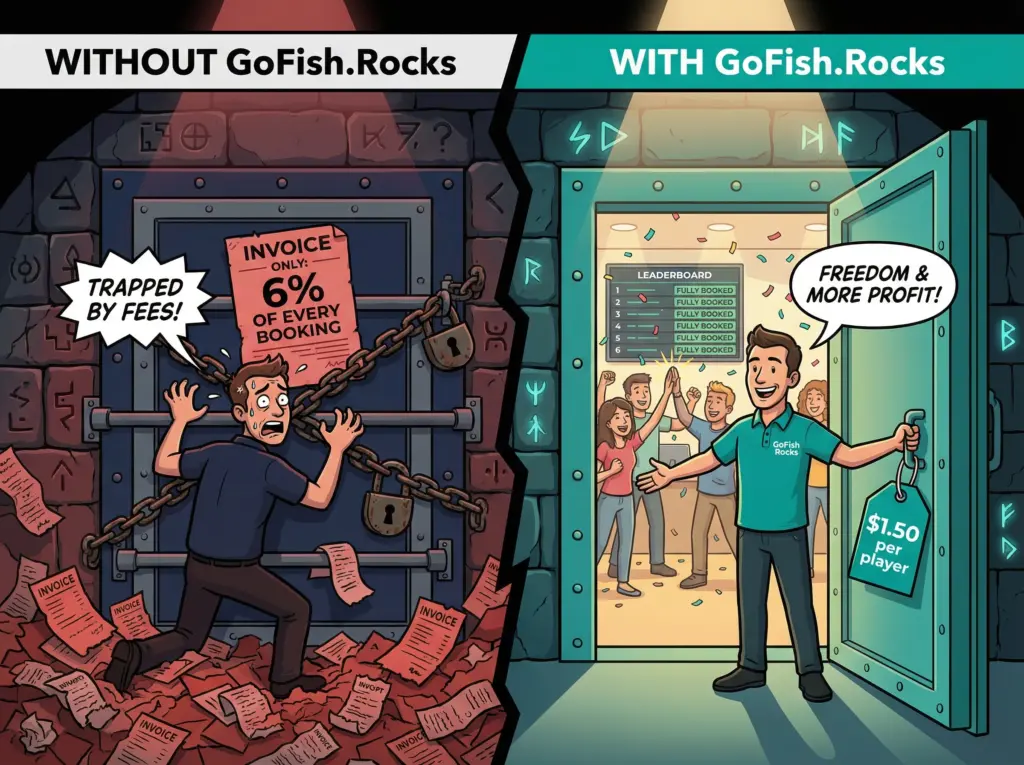
GoFish.Rocks is built for charter captains, from solo six-pack operators to full party boat fleets. Guests book and pay on your own website, payments land in your own account, and reminders go out on their own. It costs a flat $1.50 per person, billed at the end of the month, with no charge on canceled trips. See the pricing page for details, or read what captains told us they need in 5 must-haves for captains and guides.
Already booking somewhere else? Setup, training and migration are free. Check out our fishing charter booking software page, then get your free demo or call 805-871-0044.
Frequently asked questions
What captain’s license do I need to run a fishing charter?
For up to six paying passengers on an uninspected boat, most captains get the OUPV, also called the six-pack license. More than six passengers usually means a Master license and an inspected vessel.
How many days of sea time do I need for a captain’s license?
The OUPV requires 360 days of documented sea time. Master licenses require 360 to 720 days depending on tonnage and route.
What else do I need besides sea time?
A TWIC card, a physical exam, a DOT 5-panel drug test, CPR and first aid certification, a passed exam and an application to the National Maritime Center.
How long is a captain’s license good for?
A Coast Guard credential is valid for five years, then it needs to be renewed.
Licensed? Now get booked.
Online booking, payments to your own account and automatic reminders for a flat $1.50 per person. See Charter Booking →