
How to Handle Weather Trip Cancellations
The wind is not your fault. The next thirty minutes are. Here is the playbook for making the call, telling every guest with proof they got the word, and keeping the money on the books.
 The GoFish.Rocks Team
•
July 19, 2026
•
6 min read
The GoFish.Rocks Team
•
July 19, 2026
•
6 min read
A weather cancellation can turn a full manifest into a phone queue in about ten minutes.
Knowing how to handle weather trip cancellations is not really about avoiding complaints. It is about protecting your passengers, your crew, your boat, and the money you already booked.
The operators who handle blow-out days best are not the ones who never cancel. They are the ones with a clear policy, a fast decision, and one message that reaches every guest at once, with proof it landed.
Guests can forgive the wind. What they remember is how you handled it.
First rule: one person makes the call
Make the Call Early, and Make It Once
The captain or one named operations lead owns the weather call. Not the group chat, not the reviews page, and not a guest who says it looks fine from his porch.
Set your limits before the season gets busy. Wind speed and direction, wave height, lightning distance, visibility, tide, and small craft advisories should all have numbers your crew knows.
Those limits change with the trip. A six-foot sea can be a workday for an offshore crew. It is dead wrong for a sunset cruise full of families and first-timers.
Leave room for the captain’s judgment, too. A forecast does not know your inlet, your boat, or how fast that squall line is moving. Do not write a policy that forces a bad trip just because one number on a weather app looks okay.
Write a Weather Policy Guests Can Actually Read
A good policy is short, plain, and posted before checkout. It says three things: safety decides, the captain has the final word, and here is what happens to your money.
“Weather permitting” with no details is not a policy. It is an argument waiting for a dock to happen on.
The fairest structure for most operators is simple. If you cancel the trip for safety, offer a new date first. If a new date does not work, give a full refund. Rebooking keeps the revenue. The refund option keeps the trust.
Be careful with a flat “no refunds for weather” rule. It feels like protection, but when your business cancels the trip and keeps the money, you are buying chargebacks and one-star reviews at full price.
Cover partial trips, too. Coming back two hours into a six-hour charter is not the same as finishing most of a sunset cruise before the rain. Write the general rule down, and let the captain and owner use judgment on the weird ones.
Guests can accept that nobody controls the ocean. They cannot accept that nobody answered the phone.
One Button: Trip Is a Go, or Trip Is a Cancel
Here is why cancellation mornings eat your whole day: it is not that texting guests is hard. It is that you have to verify every single guest actually got the word. That is the real reason crews end up making thirty phone calls in a rainstorm — a text you cannot confirm was seen is a guest who still shows up at the dock.
This is exactly the job we built GoFish.Rocks to do. When the captain makes the call, the office clicks one of two buttons on the trip: Trip Is a Go or Trip Is a Cancel.
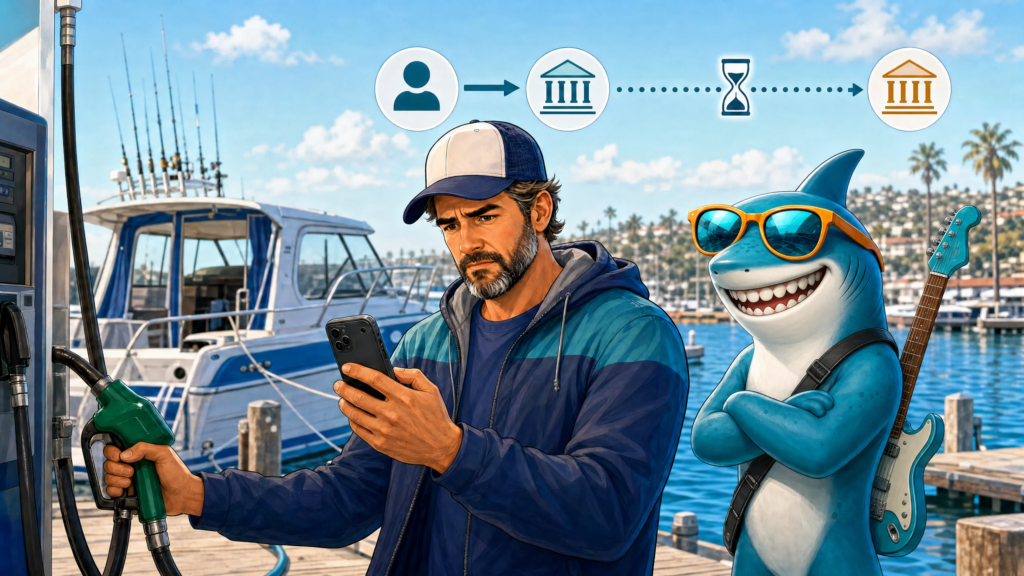
One click, and every passenger on the manifest gets a text message with a link that is unique to that person: “You have an important message from the boat.” The moment a guest taps it, your manifest is marked with an IP number and a timestamp — hard proof that guest received the notice that the trip is canceled.
On average, most people open that message within about seven minutes. So instead of a morning of phone calls, you get a manifest that fills itself in with green checkmarks while you deal with the boat. If a name has not opened after a while, you call that one person — not all twenty-eight.
And the button works in both directions. If the weather looks iffy but you know your inlet and the trip is safe, hit Trip Is a Go and the same verified message goes out telling everyone the boat is running and to show up. No half-empty boat full of guests who assumed the worst.
How to Handle the Money: Credits First, Zero Fees
The moment you cancel, speed is everything. Guests need one clear message from the business, not a mix of calls, social posts, and voicemails.
Your message has four jobs: the trip is canceled, the reason is safety, the boat is not going out, and the guest has one specific next step.
Notice what that message does not say: “contact us for options.” Every extra step you make a guest take becomes a phone call your staff has to answer during the busiest hour of a weather event.
Now the part most platforms get wrong: the fees. On most booking systems, a canceled trip still costs you — commission on money you have to give back, processing fees you eat, or both.
On GoFish.Rocks, a weather cancel costs you zero. Every passenger who did not sail becomes a credit they can rebook or reassign, and we charge you nothing on any of it. No booking fees on a trip that never left the dock. You are already losing the day’s revenue — you should not be paying fees on top of it.
Give the Crew One Script
Guests ask the same three questions every time. “It looks fine where I am.” “That other boat is going out.” “Can we just wait at the dock?”
Give your staff one answer: the captain made the call based on conditions for this boat and this trip, safety is not a debate, and here are your options. A dockhand or a social media manager should never be arguing the captain’s judgment with a customer.
For groups, work with the person who paid. Six friends on one reservation should get one resolution, not six different promises from six phone calls.
Rebook First, Refund Fast
A canceled trip does not have to be lost revenue. The best time to rebook a guest is right now, while they are still disappointed and still interested. That is the whole point of the credit: the money stays on your books, and the guest already has a reason to come back. Offer real dates, not “come back and see us sometime.”
Offer the closest match first. If the afternoon whale watch is canceled, show the next afternoon departure. Do not quietly move an offshore group to an inshore trip and hope nobody notices the difference.
Waitlists earn their keep on weather weeks. When Saturday blows out and Sunday is gorgeous, those open Sunday seats go fast. Work the list in booking order (a rule your crew can apply without playing favorites) and the boat fills itself.
In peak season, consider holding a seat or two for weather-displaced guests. You give up a little new-booking inventory, but a rebooked guest is already paid, already excited, and very likely to leave a five-star review after you take care of them.
Do
- Turn weather-canceled guests into credits they can rebook or reassign
- Start any refund the same day and tell the guest you did
- Keep weather cancels separate from normal guest cancellations
- Log the reason for every canceled trip
Don’t
- Sit on refunds until someone calls twice
- Apply your no-show policy to a trip you canceled
- Promise different deals to different guests on the same boat
- Pay booking fees on a trip that never sailed
One more reason to log every cancellation: the patterns pay you back. Certain departure times fail more often. Certain months eat trips. After a season of notes, you can schedule around the weather instead of just reacting to it.
A Bad Forecast Can Still Earn a Five-Star Review
Guests almost never blame a professional operator for refusing to put them on rough water. They blame businesses that go quiet, make them chase answers, or treat a ruined vacation day like it is the customer’s problem.
So use the cancellation to show off how organized you are. One button, every guest notified and verified within minutes, credits issued on the spot, and a follow-up to confirm the new date or the refund. (Skip the sales pitch in that follow-up. They will remember that you did.)
Weather will always cancel trips. It should not also charge you fees. We built GoFish.Rocks to be on your side of the rail: we only make money when you make money. When weather cancels your trip, you lose the day and so do we — and we waive our fees, because you are already having a bad day.
If your current setup turns every blown-out Saturday into an all-day job, the problem may be the tools, not the team. Our guide to the best fishing charter booking software covers exactly what to look for, including how a platform should handle the worst Saturday of your season.
Weather Cancellation FAQ
Do charter trips get refunded for bad weather?
When the operator cancels for safety, the standard is a new date or a credit first, with a full refund if rebooking does not work. When a guest cancels on their own, the operator’s normal cancellation policy applies instead.
Who decides if a trip is canceled for weather?
The captain, or one named operations lead. Forecasts help, but the final call belongs to the person responsible for the vessel and the passengers, and it should never be up for debate at the dock.
How do you make sure every guest knows the trip is canceled?
Send every passenger a text with a unique link and track who opens it. GoFish.Rocks does this with one click: the manifest is stamped with an IP address and timestamp as each guest opens the message, and most guests open it within about seven minutes. Then you only call the stragglers.
Does the booking platform charge fees when weather cancels a trip?
GoFish.Rocks does not. Weather-canceled passengers become credits they can rebook or reassign at no charge, and the operator pays zero fees on the canceled trip. The flat $1.50 per passenger applies only to trips that actually run.
What should a weather cancellation message include?
Four things: the trip is canceled, the reason is safety, the boat is not departing, and one specific next step, such as choosing a new date, using a credit, or a full refund by a stated deadline.
Cancel a trip in minutes, not all day
One tap marks the trip a go or a cancel, texts every guest a unique verified link, and stamps your manifest with proof they saw it — most within seven minutes. Flat $1.50 per passenger, and $0 in fees when weather cancels the trip.
Get Your Free Demo →