
Best Fishing Charter Booking Software for Captains
Fill your seats, keep the manifest straight, make the weather call painless, and stop handing a percentage of every trip to a software company. Here is what to look for, with the math to back it up.
 The GoFish.Rocks Team
•
July 12, 2026
•
6 min read
The GoFish.Rocks Team
•
July 12, 2026
•
6 min read
Somewhere right now, a captain is handing 6% of a full boat to a software company that has never tied off a cleat.
The best fishing charter booking software should do the opposite of that: fill your seats, keep your manifest straight, make the weather call painless, and charge a flat fee that stays flat when your prices go up.
That is the short version. Here is how to actually pick one.
First, the job description
What the Best Fishing Charter Booking Software Has to Handle
A booking platform built for salons and yoga studios thinks a schedule is a grid of one-hour slots.
Your schedule is a half-day inshore trip at 7 AM, a full-day offshore run, a sunset cruise with 40 tickets, and a private charter that just called to move to Thursday. All of it on one calendar, and none of it allowed to double-book.
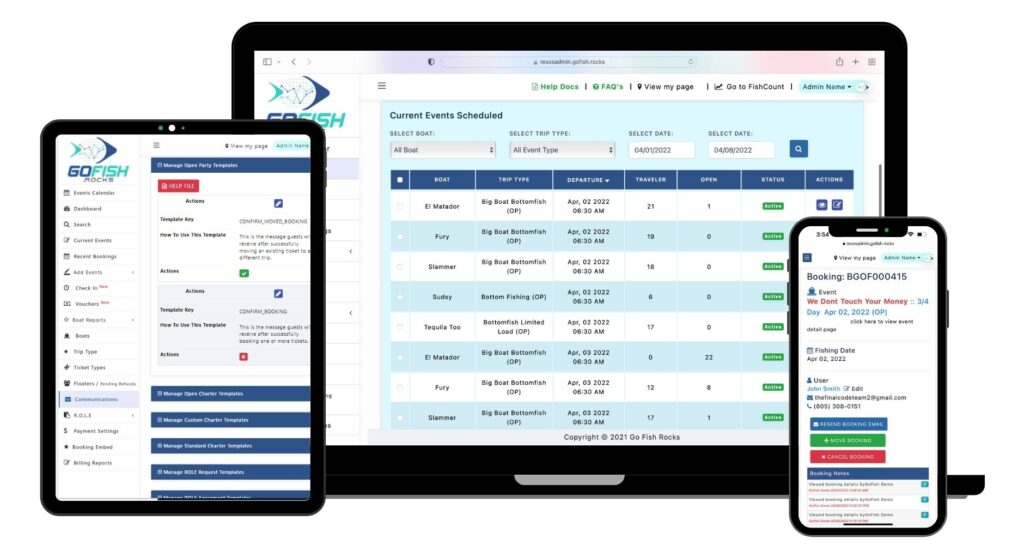
Real booking and scheduling tools for charter work handle the whole picture. Customers see what is actually open, whether that is a whole boat or three seats on a headboat.
Your crew can add walk-ups at the dock, hold spots for the regular who always pays cash, and take phone bookings without a second spreadsheet. Deposits on private charters, full payment on ticketed trips, because those are different sales and your software should know the difference.
And it keeps a manifest your deckhand can actually use. Names, headcounts, who paid, who owes a balance, who left a note about a birthday.
On a party boat, the manifest is not paperwork. It is how the morning goes smoothly instead of sideways.
The Fee Question Nobody Asks During the Demo
Percentage pricing is the quiet one. It looks tiny on the sales page and grows every time you do well. So skip the sales page and use a real boat: a headboat running 30 passengers at $200 a ticket. That is $6,000 in bookings every time you leave the dock.
Here is what that one trip pays in software fees, platform by platform, at each platform’s published rate:
| Platform & published rate | One trip 30 × $200 = $6,000 | 100 trips a season |
|---|---|---|
| Peek ProUp to 8% per booking (Bokun’s 2026 pricing guide, confirmed by CaptainBook) | $480 | $48,000 |
| FareHarborUp to 6% on direct bookings, passed to your customers at checkout (Bokun’s 2026 pricing guide) | $360 | $36,000 |
| Origin5% service fee added at your customer’s checkout (Origin’s published pricing) | $300 | $30,000 |
| Rezdy3% per online booking, plus a $49–$249 monthly plan (Rezdy’s pricing page) | $180 | $18,000 + plan |
| GoFish.RocksFlat rateFlat $1.50 per passenger per trip, $0 when weather cancels | $45 | $4,500 |
Sources: Peek Pro rate per Bokun’s published 2026 Peek Pro pricing guide, confirmed by CaptainBook’s independent comparison; FareHarbor rate per Bokun’s FareHarbor pricing guide; Origin and Rezdy rates from each platform’s own published pricing, all as of July 2026. Rates can change or vary by contract; confirm current terms with each vendor. FareHarbor and Origin pass their fees to your customers at checkout — the money still comes out of what your customers are willing to pay for a trip. Software fees only — card processing (typically about 2.3% + 30¢) is separate on every platform, so it cancels out of the comparison. All trademarks belong to their respective owners; GoFish.Rocks is not affiliated with or endorsed by any of them.
$480, or $45. What would you rather pay?
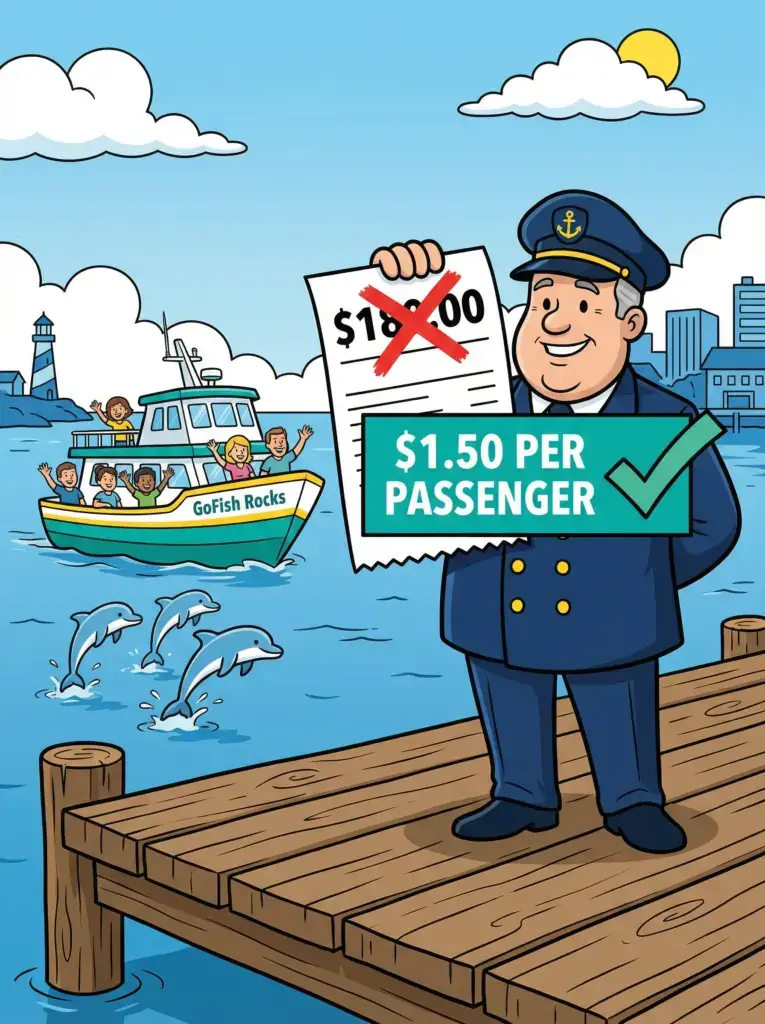
Same trip, same passengers, same job for the software. At 8%, you hand over $480 every time that boat leaves the dock. At a flat $1.50 a head, it is $45. Run 100 trips a season and that is $48,000 gone versus $4,500 — about $43,500 a year that stays in your pocket for the same service.
Keep that up for ten years and you are closing in on half a million dollars. That is not a software fee anymore. That is your next boat.
Revenue is vanity. Take-home is sanity.
Percentage models can earn their keep when a marketplace is genuinely sending you customers you would not have found. But if your bookings come from your own website, repeat clients, the marina, and word of mouth (which, for most established operations, is exactly where they come from), you are paying a commission on customers you already earned.
Don't take the table's word for it. Put your own numbers in:
Run Your Own Season
Your trips, your prices. See what each model costs you per year.
Estimates use your averages and compare software fees only. See full pricing for charter minimums.
Read the whole fee schedule before you sign anything, whoever you sign with. Monthly minimums, setup charges, contracts, cancellation penalties, charges for text messages and waivers. A cheap headline rate with six add-ons is not a cheap rate.
How the Big Platforms Stack Up
There are five names you will run into the moment you start shopping, and each one is built for a slightly different business. Here is the honest lay of the land, using each platform’s published rates:
| Platform | Published software cost | Built for |
|---|---|---|
| FareHarbor | Up to 6% per booking, bundled card processing | Operators who want Booking.com-family OTA distribution |
| Peek Pro | Up to 8% per booking (per Bokun’s 2026 pricing guide; contract-dependent), processing separate | Multi-activity tour businesses that want one broad platform |
| Rezdy | $49 to $249 per month, plus about 3% per online booking | Operators selling through agents and reseller channels worldwide |
| Origin | 5% service fee added at your customer’s checkout, plus card processing | Outdoor recreation brands that want a polished direct-booking site |
| GoFish.RocksFlat rate | $1.50 per passenger per trip, $0 when weather cancels | Charters and party boats that fill their own calendar |
Rates are each platform's published pricing as of July 2026 and can change or vary by contract; confirm current terms with each vendor. Peek Pro's rate is as published in Bokun's 2026 pricing guide and confirmed by CaptainBook's comparison. FareHarbor, Peek Pro, Rezdy, and Origin are trademarks of their respective owners. GoFish.Rocks is not affiliated with or endorsed by any of them.
All four of those platforms are real businesses with real strengths, and if a marketplace is filling half your calendar, the percentage may be buying you something.
The pattern to notice is simpler: every one of them charges more when you charge more, whether the fee lands on you or gets stacked onto your customer’s checkout total. A flat rate is the only model on the list where a $2,500 two-day offshore trip and a $75 inshore seat cost the same to book.
The full head-to-head breakdowns are linked in the table if you want to go deeper on any of them.
Messages That Send Themselves
Every no-show has the same backstory: somebody did not know where the dock was, what time to show up, or that the trip was still on after yesterday’s wind.
Automated customer communication fixes most of that before it starts. A confirmation that spells out the meeting spot, parking, what to bring, and your weather policy.
A reminder the day before that quietly cuts down the 6 AM phone calls. A review request after the trip, sent while the cooler is still full and everyone is happy. None of it should require your office manager to remember anything.
Waitlists belong in the same category of money you are currently leaving on the dock.
When a popular trip fills, capture the next name instead of waving them off. When a seat opens up (and one always does), fill it in minutes instead of working a handwritten list between phone calls.
When the Forecast Falls Apart
This is where good software separates itself from software that only looks good in a demo. The fish do not check your calendar, and neither does the wind.
When you cancel a trip, the whole job should take minutes: pull up the affected passengers, notify everyone by text and email at once, offer a new date or a credit, and keep the payment records clean.
If canceling a trip means an afternoon of phone calls and a week of refund spreadsheets, the software is working against you.
Watch how a platform handles the two very different versions of this problem.
A headboat cancellation might mean moving 18 separate reservations. A private charter cancellation means moving one high-dollar booking held by a customer who booked flights around it. Those are different jobs, and the system should be good at both.
On some platforms, a blown-out Saturday still triggers fees on the refunds. That is paying twice for a trip that never left the slip.
Support That Picks Up on Saturday Morning
Every provider promises great support. The test is simple: who answers, when, and do they know what a manifest is?
A ticket queue with a 48-hour response window is fine for an online store. It is useless when your departure is in two hours, a customer cannot check out, and every empty seat is revenue you never get back.
Ask for the support number during the sales call and note whether one exists.
Switching platforms is the other place support gets real. Your schedule, customer history, trip types, and future bookings all have to land intact.
A provider offering free setup and hands-on migration has removed the biggest excuse for staying with software you have outgrown. You run a boat, not a data-entry department.
Where GoFish.Rocks Fits
GoFish.Rocks was built for fishing charters and other ticketed trips on the water, and the pricing says so: $1.50 per passenger per trip, flat.
No subscription, no setup fee, no contract, and no fee when weather kills a trip. If you do not get paid, neither does the software.
Everything runs in one place: bookings, scheduling, manifests, waitlists, automated texts and emails, review management, and billing.
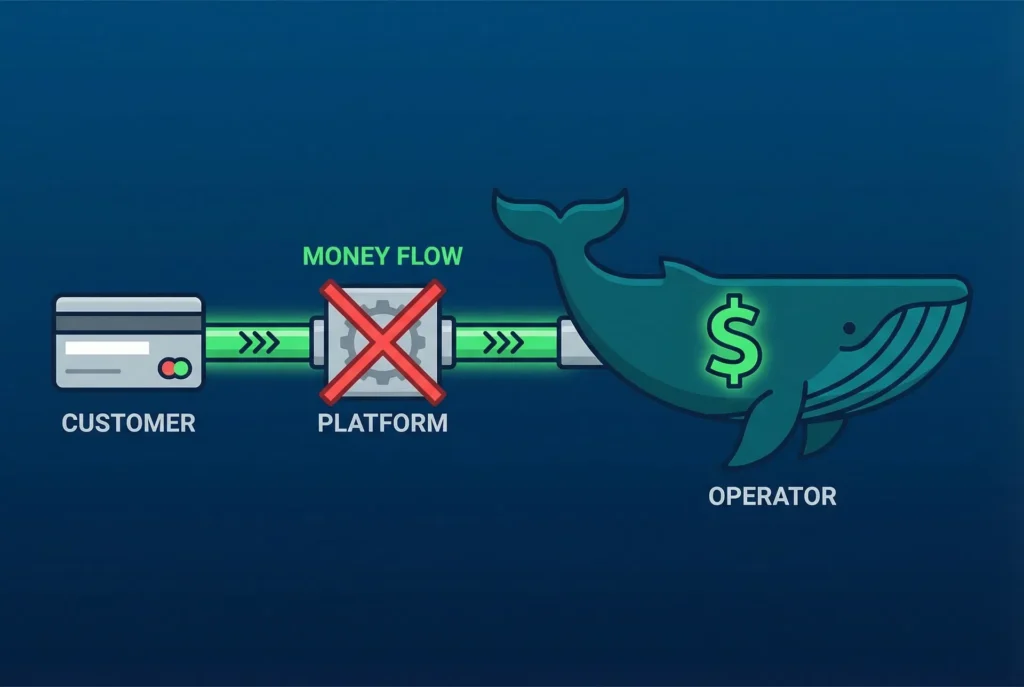
Payments go straight to you through your own merchant account rather than sitting in a platform’s holding tank, and support is a live person in the US who has heard the phrase “small craft advisory” before.
Is flat pricing right for everyone? Honestly, no. An operator who depends on a marketplace to generate demand is buying distribution, and that is a different purchase. But if you fill your own calendar, paying a percentage of your own success is a hard habit to defend.
Take This List to Every Demo
Skip the feature checklist the salesperson hands you and map your actual worst Saturday instead. Then make every vendor show you, on screen, how their system handles exactly this:
The Worst-Saturday Demo Test
If they can't show it live, that is your answer.
- Cancel a headboat trip with 18 passengers. Time how long it takes to notify everyone and issue credits.
- Move a $1,200 private charter to next Thursday. Deposit, balance, and confirmation should follow it automatically.
- Add a walk-up at the dock while the online calendar stays accurate.
- Fill an empty seat from the waitlist without picking up the phone.
- Show the real total fee on a full 30-passenger, $6,000 trip: software, add-ons, messaging, everything.
- Call support at 6 AM on a Saturday. Ask who picks up. Better yet, actually call.
Do the same with cost. Take your average trip value and passenger count and run the real annual number, the way the calculator above does: software fees, payment fees, add-ons, and whatever the contract charges you for leaving.
The best fishing charter booking software is the one that makes booking easier for your customers, keeps your crew in control at the dock, and leaves the biggest share of every hard-earned trip where it belongs.
Your boat and your reputation fill the calendar. The software’s job is to keep up, not to take a cut for watching.
Come run that demo test on us. Free setup, free migration from whatever you are on now, and a real person in the US who picks up the phone.
Charter Booking Software FAQ
What does fishing charter booking software cost?
It depends on the model. Percentage platforms publish rates from about 3% up to 8% of every booking, so the cost rises with your prices and your volume — on a $6,000 headboat trip, that is $180 to $480 in software fees for one departure. Flat-rate platforms charge per passenger: that same 30-passenger trip costs $45 at a flat $1.50 a head, and a $1,200 charter with six anglers costs $9, whether it is a slow Tuesday or the Fourth of July.
Is a flat rate or a percentage fee better for charter operators?
If a marketplace genuinely sends you customers you would not have found, a percentage can be worth it. If your bookings come from your own website, repeat clients, and referrals, a percentage is a commission on customers you already earned, and a flat rate keeps that money in the business.
What features matter most in charter booking software?
Real-time availability that prevents double-booking, manifests the crew can use at the dock, deposits and balance collection, automated confirmations and reminders, waitlists, and a fast way to notify every passenger when weather cancels a trip.
How hard is it to switch booking platforms mid-season?
Easier than most operators expect, if the new provider does the lifting. Look for free setup and hands-on migration so your schedule, customer history, and future bookings come across intact. You run a boat, not a data-entry department.
Keep more of every trip
Flat $1.50 per passenger. No subscription, no contract, no fee when weather cancels. Free setup, free migration, a real US-based person who picks up the phone.
Get Your Free Demo →